Tour of Major Shilla Cultural Sites
We are currently preparing a tour package for Saturday, Sept. 4, 1999, which
will include visits to the cultural sites (see below).
Please click English or
Japanese for detailed schedule and fare information.
The Shilla Cultural Zone refers to an area centered around Kyongju, the capital
of the Shilla Kingdom (57B.C.- A.D.935). A unique characteristic of Shilla is
its accommodation of elements from Chinese culture. Although the ruling elite
of Shilla, which developed into a centralized aristocracy, welcomed Chinese
culture, they did not merely imitate foreign culture. Instead, they constantly
strove to adapt foreign elements to the local life-style.
Pulguksa Temple
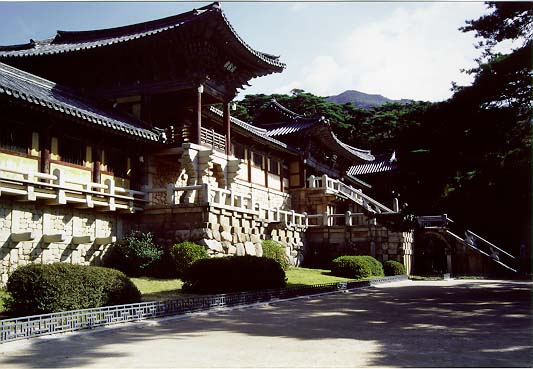 "Temple of the Buddha Land," Pulguk Temple is one of Korea's most famous
temples. Home to some of the finest treasures of Korean Buddhism, the temple
was built in 751 during the Shilla Kingdom. The temple served primarily as a
place to pray for the protection of Shilla against foreign invaders. Its
pagodas testify to the rich culture of the Shilla people. Many wooden pagodas
were built during that period, but only stone pagodas remain today. Most of
the wooden buildings have been rebuilt over the centuries, all the stone
bridges, stairways and pagodas are original.
"Temple of the Buddha Land," Pulguk Temple is one of Korea's most famous
temples. Home to some of the finest treasures of Korean Buddhism, the temple
was built in 751 during the Shilla Kingdom. The temple served primarily as a
place to pray for the protection of Shilla against foreign invaders. Its
pagodas testify to the rich culture of the Shilla people. Many wooden pagodas
were built during that period, but only stone pagodas remain today. Most of
the wooden buildings have been rebuilt over the centuries, all the stone
bridges, stairways and pagodas are original.
Sokkuram
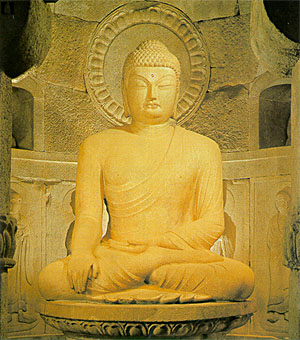 Construction of the Sokkuram grotto was launched in 751 A.D. by Kim Tae-song,
Prime Minister of the Shilla Kingdom, as a memorial to his dead parents.
Construction was completed in 774. Buddhist grottoes are generally believed
to have originated in ancient India. Sokkuram is a chaitya-style grotto,
that is, a sanctuary lined with pillars and statues with a stupa at its focal
point. It is considered one of the most outstanding Buddhist grottoes because
of its ingenious dimensions, exceptional sculpturing techniques and unique
spatial arrangement.
The grotto consists of a 14.8 meter-high antechamber, a corridor and main
rotunda. The layout of the grotto shrine is remarkable for its religious
symbolism and for its architectural beauty and mathematical precision.
Sokkuram and nearby Pulguk Temple have been included on the UNESCO World
Heritage Committee's World Heritage List in recognition of their cultural
and historical value, not only for Koreans but for all humanity.
Construction of the Sokkuram grotto was launched in 751 A.D. by Kim Tae-song,
Prime Minister of the Shilla Kingdom, as a memorial to his dead parents.
Construction was completed in 774. Buddhist grottoes are generally believed
to have originated in ancient India. Sokkuram is a chaitya-style grotto,
that is, a sanctuary lined with pillars and statues with a stupa at its focal
point. It is considered one of the most outstanding Buddhist grottoes because
of its ingenious dimensions, exceptional sculpturing techniques and unique
spatial arrangement.
The grotto consists of a 14.8 meter-high antechamber, a corridor and main
rotunda. The layout of the grotto shrine is remarkable for its religious
symbolism and for its architectural beauty and mathematical precision.
Sokkuram and nearby Pulguk Temple have been included on the UNESCO World
Heritage Committee's World Heritage List in recognition of their cultural
and historical value, not only for Koreans but for all humanity.
Kyongju Folk Craft Village
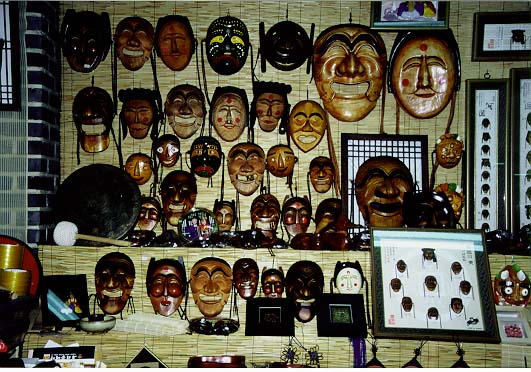 The village was established in 1986 to preserve and develop traditional
artisary of Shilla artisans. Traditional handicrafts such as metallic wares,
woodcrafts, and ceramic wares are made, displayed, and sold to tourists in
this village. Folk Craft Village is located near the road from Pomun Lake
Resort to the Pulguksa Temple. There are about thirty handicraft workshops
in this village including the "Shilla Arts and Science Museum," which has
miniatures of Sokkuram Grotto and Cheomsongdae displayed.
The village was established in 1986 to preserve and develop traditional
artisary of Shilla artisans. Traditional handicrafts such as metallic wares,
woodcrafts, and ceramic wares are made, displayed, and sold to tourists in
this village. Folk Craft Village is located near the road from Pomun Lake
Resort to the Pulguksa Temple. There are about thirty handicraft workshops
in this village including the "Shilla Arts and Science Museum," which has
miniatures of Sokkuram Grotto and Cheomsongdae displayed.